 Welcome
 Play SlideShow Below
"Cordoda Spain 2010"
|
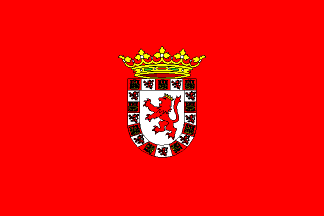
Cordoba started as an Iberian settlement in 169 B.C., providing it with a mix of Carthaginian, Greek and Punic influences. Evidence of the Iberian presence – cups, sculptures and other everyday items can be found at the Archeological Museum. The Roman governor Claudius Marcelus developed this into a city, most probably because of its strategic location on the Guadalquivir River. Under Pax Romana, it blossomed into a port city of great importance. Agriculture, mining and the olive trade thrived at this time. At present, vestiges of the Roman presence can be seen in structures such as the El Puente Romano, the bridge which spans the Guadalquivir River, the Roman Theater, Roman Walls, Aqueduct and other structures. Cordoba reached the height of its glory under the rule of the Moors, who wrested Cordoba from the hands of the Romans in 711. Cordoba was proclaimed an emirate under the rule of the Damascus caliphate. In 756, Abd al-Rahman I rose to power and declared Cordoba independent of Damascus. It was in this era that Cordoba started to emerge as the biggest and greatest city in the world. The Requenquista (Reconquering) campaign waged by Spain ended the era of the Moors. In 1236, Cordoba fell into the hands of the Catholic Kings, particularly Ferdinand III. Ferdinand III entered the city and gained control of it. He ordered the construction of the cathedral at the very center of the Mezquita. In different parts of the city, there was a flurry of construction activities – most of the cathedrals and monasteries built during this time still stand today.
 Click to view SlideShow |